What the LeapFrog Preschool Game and Go Actually Teaches a 4-Year-Old
Posted on 2026-10-12 by Diego Salazar
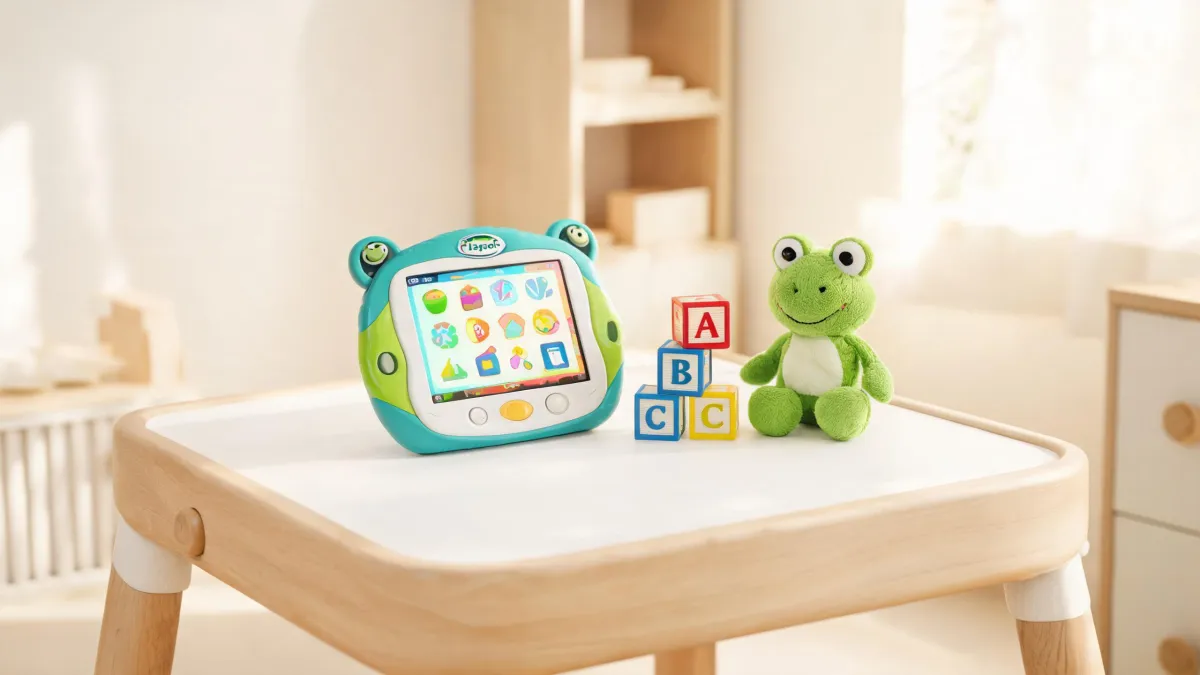
A handheld learning toy sells for somewhere between thirty and forty dollars, and the price tag is the cheapest part of getting it wrong. The real cost lands around week three: a four-year-old handed a machine pitched two stages above where he actually is stops reaching for it, and the ten minutes you carved out for letters turns into a daily negotiation. The other failure is quieter. A parent buys the gadget so they can stop sitting on the floor with a workbook, the kid spends a month tapping bubbles, and nobody ever checks whether a single letter sound stuck.
The LeapFrog Preschool Game and Go is worth the money for one narrow kind of child: the one who still needs reps on letter sounds and on recognizing numbers, letters, and shapes. That is what is inside it, six small games built around those skills inside a body shaped like an old handheld game system (P01-Q1, P01-Q2). Expect it to replace a preschool curriculum, teach handwriting, or babysit on its own, and you have bought the wrong thing.
Rank the Skills Before You Rank the Games
Parents almost always open with the same question: how many games does it have? Here the answer is six (P01-Q1), and six sounds like either a lot or a little depending entirely on your kid. Counting them first is the mistake, because game count is the last thing that predicts whether the toy gets played. A six-game machine aimed at exactly the skill your child is working on gets used every day. A fifteen-game machine that misses gets one game played and fourteen ignored, which means you paid full price for a fraction of a product.
So screen in this order. First, does the toy cover a skill sitting inside your child's current developmental window? This one covers numbers, letters, and shapes (P01-Q1), plus letter sounds (P01-Q2). Second, has your child already nailed those? If she names every letter and counts to twenty with one-to-one matching, there is nothing here for her, and you should skip it. Third, and only third, do game count, price, and brand get a vote.
The age line matters more than the label on the box. Most three-year-olds are still working on shape names and letter names. Letter sounds and matching a numeral to a quantity usually land closer to four and five. Same machine, two very different verdicts. Most people assume more games means more value. In fact the narrower the skill band and the closer it sits to what your child is doing right now, the more often she replays it, and the lower your cost per real minute of practice.
I watched this play out with a neighbor's four-year-old. He got one of these in spring and ignored four of the six games for a month. Once letter sounds clicked in preschool, the bubble game became the only thing he wanted. Nothing about the toy changed. His skill window moved.
The Real Alternatives Sitting Next to It
The comparison most parents make is wrong from the first line. They line this up against a free phonics app on the phone and conclude it loses, because the app claims endless content and this has six built-in games (P01-Q1). Judging a physical toy on content volume guarantees a bad verdict, and it hides the choice you are actually making.
Split the options by where they get used, then compare inside each group. In the handheld group there is this device, built to look and feel like a classic handheld game system (P01-Q1). In the app group there is whatever is already on your phone: more content, no physical buttons, one swipe away from video. In the paper group there is a workbook, five dollars, no battery, no sound feedback. In the wider LeapFrog family there are bigger screens with more games, which also cost more and are harder to cap at ten minutes.
In the car, in the ten minutes before dinner, in a waiting room, the handheld and the app are not the same product. One you hand over and it stays inside the six games you already vetted. The other you hand over with an unlocked phone and hope.
Why It Earns a Spot, and When It Doesn't
"Preschool" is not one age, and treating it as one is where money gets burned. Give this to a five-year-old who already blends simple words and it is dismissed as babyish inside two weeks. Hand it to a three-year-old and open the letter-sound game first, and she hears noise she cannot map to anything, so she taps randomly and you decide the toy is broken. Neither child is wrong. The skill band is.
Buy it when the child needs practice on letter sounds and on number, letter, and shape recognition (P01-Q1, P01-Q2), and when you specifically want screen time capped at six mini-games with real buttons instead of a swipe. Buy it when you plan to sit nearby for the first week and hand it back.
Skip it if you want handwriting, blending sounds into words, or sight words, because none of that is in here. Skip it if your child has already moved past those skills, because it will sit in a drawer. And skip it if you intend to hand it over and walk away, because the games will never tell you what your child failed to learn. Most people assume earlier is better. In fact a toy aimed past a child's stage teaches one durable lesson, that learning is a chore, and that lesson outlasts the toy.
What the Bubble Game Teaches, and What It Can't
One game has the child pop bubbles to work on letter sounds (P01-Q2). Read that line and it is easy to assume the child is learning to read. He is not. He is learning that this letter makes this sound, which comes before reading rather than being reading. Blending, pushing those sounds together into a word and then recognizing the word on sight, happens somewhere else, with you or with another material.
Give it five to ten minutes, sit close, and say the sound out loud yourself as each bubble pops. That turns a tapping exercise into a sound drill. Most people assume clearing a game equals learning it. In fact the only check that counts happens away from the screen: hand the child a letter magnet or a cereal box and see whether he names the sound with no toy in front of him.
Size, Hands, and the Car-Seat Test
Nobody asks who is holding it until the box arrives. Then the complaints start: too big for one hand, too wide for the seat-back tray, nowhere to store it. The body measures 4.1 by 5.6 by 1.3 inches (P01-Q3). That is roughly an old handheld's footprint, shorter than a tablet, wider and thicker than a phone, holdable with two hands and pressable with one.
Before ordering, measure three things: your child's palm width, the tray of the car seat or high chair where it will actually live, and the pocket or bin it goes back into. The 1.3-inch thickness means one hand can clamp it, and it slides into a backpack side pocket without bulging. What you give up for that thin body is a small screen with a narrow viewing angle, so sit shoulder to shoulder rather than across the room, or your child will tilt her head to chase the picture.
What you get for the money is six mini-games on real buttons and screen time that ends when the games end (P01-Q1). What you give up is handwriting, blending into words, adjustable difficulty, and the fantasy of a toy that raises your reader for you. If your child is sitting in the letter-sound and shape-and-number stage right now, it earns its spot in the bag. If she is past it, or two stages short of it, the same dollars go further as a workbook and ten minutes a day on the floor next to you.

Diego Salazar
Diego Salazar is a building and construction toy analyst covering interlocking blocks, brick sets, wooden blocks, magnetic tiles, construction kits, and three-dimensional puzzles. He uses ISO 8124-1 test methods while measuring small-part dimensions, magnet flux index, pull force, connection tolerance, drop resistance, structural stability, and assembly repeatability. He helps educators, distributors, and gift buyers compare build quality, challenge level, component compatibility, storage demands, and age suitability for open-ended or model-based play.